

The tender fit assesses what is visible about your company. That is the good news: visibility is something you can create, and it affects every future analysis, not just one.
This article describes the three sections at the end of the fit drawer that help with exactly that, and what you should change in your profile.
Quality signal from reviews
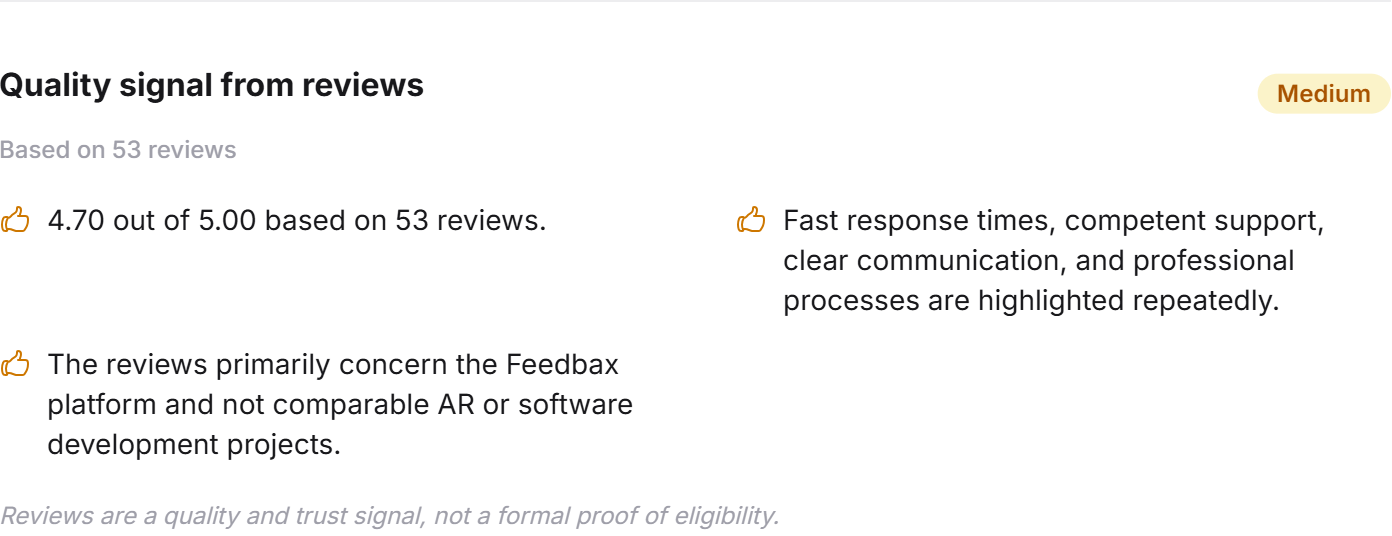
The first of these sections is called Quality signal from reviews. It shows:
a level: strong, medium, weak or none
the line Based on: N reviews
a list of recurring themes, for example fast response, communication or project management
where applicable, a caveat when the reviews only partly transfer to the services being tendered
Below it stands the decisive sentence: reviews are a quality and trust signal, not formal proof of eligibility.
Only reviews from 4.0 stars upwards feed the analysis. They deliberately do not feed the score. They are valuable nonetheless: they are the part of the analysis you can quote in your bid.
How to integrate reviews from other portals into your Feedbax profile is in Integrating reviews from other portals.
Recommendation & next steps
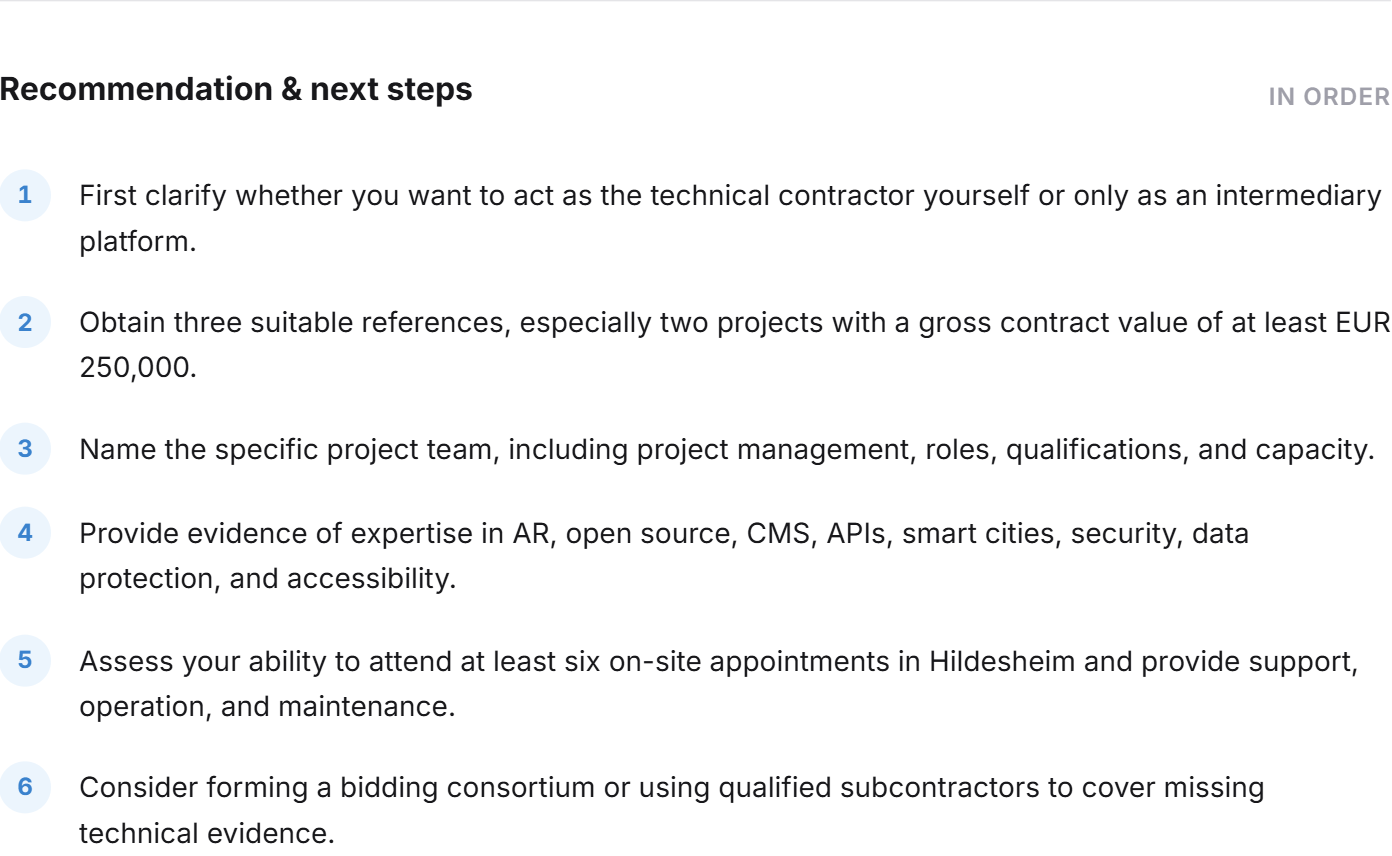
The second section carries the badge IN ORDER and lists, numbered, what has to be clarified before an application. The order is deliberate: the first item is the one that decides everything else.
Typical entries are: pick the right lot based on your strongest references, request the full evaluation criteria, secure at least one formally suitable reference, evidence certifications, confirm the language and tool skills of the intended team, and check the capacity plan.
That is a work list for your team, not a Feedbax feature. None of those items is ticked off inside Feedbax.
This is how you improve your tender fit
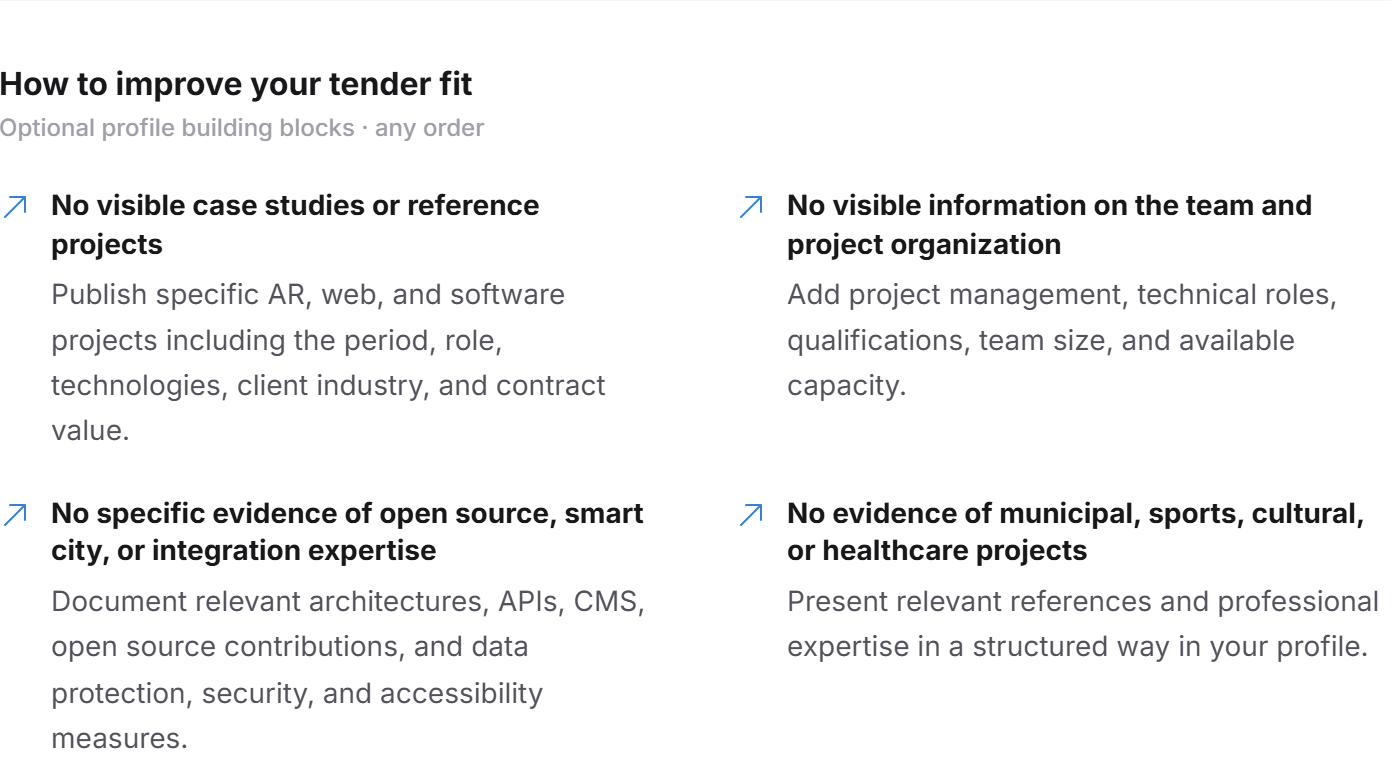
The third section is the most important one for the future. Under the heading it reads Optional profile building blocks · any order, followed by a heading and a recommendation sentence per block.
Typical blocks are:
references with buyer, period, scope and contact person
explicit evidence for norms, standards and compliance
team profiles with language and tool skills plus a capacity picture
experience with public or institutional buyers
operational services such as maintenance, support, testing and documentation
The difference to open points: open points apply to this one tender. Profile building blocks apply to all of them. One added case study raises the fit of every future tender that requests the same service.
What has the strongest effect
What feeds the analysis gives a clear order of priority.
1. Case studies
Case studies are the strongest visible signal. They feed the reference fit directly and, depending on their content, support the service, technology and industry fit as well.
Feedbax hands up to 10 case studies to the analysis, selected from a pool of 50 by relevance to the tender in question. So maintaining many pays off: the larger the pool, the better the ten that actually get used.
What matters in the content:
Name the buyer and industry, so the industry fit can engage.
State the period. More recent projects are weighted higher.
Give the scope in figures: page count, user count, number of locations, project duration.
Name technologies and systems explicitly rather than paraphrasing them.
Make results measurable.
How to create case studies is in Portfolio: key clients, awards, downloads and case studies.
2. Services and focus areas in the profile
The fit compares the requested Feedbax services with the services in your profile. If a service you deliver is missing, it is missing from the assessment too.
The same goes for focus areas. In the Fit section of a tender, Matching focus areas shows exactly the terms that count. If focus areas you master keep appearing there without being listed in your profile, you are leaving points unused.
See Expertise: weighting services and focus areas by percentage and Specializations: industries and client segments.
3. Your website
Feedbax reads up to 12,000 characters of your website and uses it as an additional source. If a certification, a norm reference or a technology is stated there but missing from the profile, the analysis can still find it.
If the website is unreachable or unreadable, that lowers the data confidence only, not your score.
4. Industries and client segments
For many providers the industry fit is the weakest of the four dimensions, because industries are often thinly maintained in the profile. Public buyers are a world of their own: anyone with experience in public administration, education, healthcare or municipal bodies should state it explicitly.
5. Company size, locations, languages
These details are not a fit dimension. They are only checked as an exclusion risk, and even then only when the tender explicitly demands them or when scope and duration clearly exceed your visible capacity.
Maintaining them correctly still pays off: if they are missing, unnecessary risk entries appear that you then have to confirm by hand.
The right order
Extend the profile: case studies, services, focus areas, industries.
Recalculate the fit in the tender. The new analysis sees the additions.
Only then confirm the remaining open points.
The other way round loses work: a recalculation rebuilds the criteria, and confirmations whose wording changed lose their match. See Working through open points and exclusion risks.
The link to the Feedbax score
Here the two coincide. Case studies, well-maintained services and reviews are exactly the things that also carry your Feedbax score and your visibility in the directories.
Anyone maintaining their profile for tenders improves their ranking at the same time. And the other way round: anyone maintaining their profile for visibility anyway gets better fit scores for free.
The tender fit itself does not change the Feedbax score.
Frequently asked questions
How quickly does a profile change affect the fit?
As soon as you click Recalculate fit. Existing analyses do not update on their own, because every recalculation is an AI analysis.
Do I have to recalculate every tender after extending my profile?
No. Recalculate the ones you are actually working on. New analyses use the current profile state anyway.
How many case studies make sense?
As many as possible, but at least enough that each of your core disciplines has one. Feedbax picks the ten most relevant per tender from a pool of 50.
Do old case studies still count?
Yes, but with less weight. More recent and more closely matching projects are weighted higher. A 2019 project with the matching technology is still better than none.
My reviews are excellent, yet the fit stays mediocre.
That is normal and intended. Reviews do not feed the score. They stand separately as a quality signal. The score measures the substantive match, and you improve that through case studies, services and focus areas.
Can I see which building blocks pay off most?
The This is how you improve your tender fit section lists them in any order, without weighting. As a rule of thumb: whatever appears in the open points of several dimensions at once pays off most.